


• Home
  • /
  • Shop
  • /
  • Megger BITE5 Advanced Battery Tester

Megger BITE5 Advanced Battery Tester

$7,535.00

Need it Sooner? Lead Time: 3 weeks

SKU: BITE5-ADV Categories: , ,

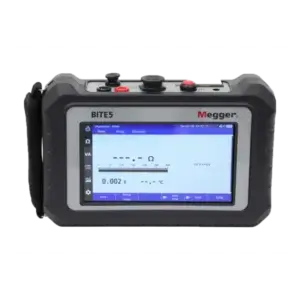
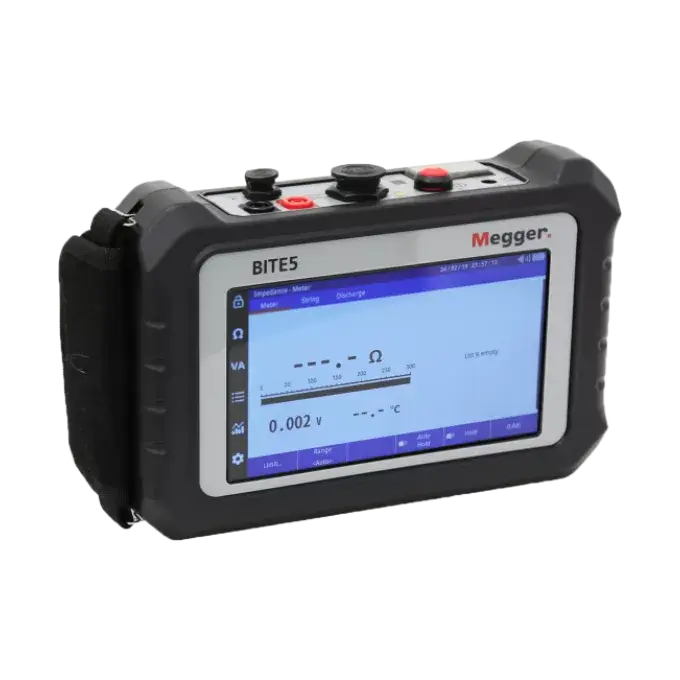
Impedance, or ohmic, tester for lead-acid, NiCD, and lithium-ion batteries

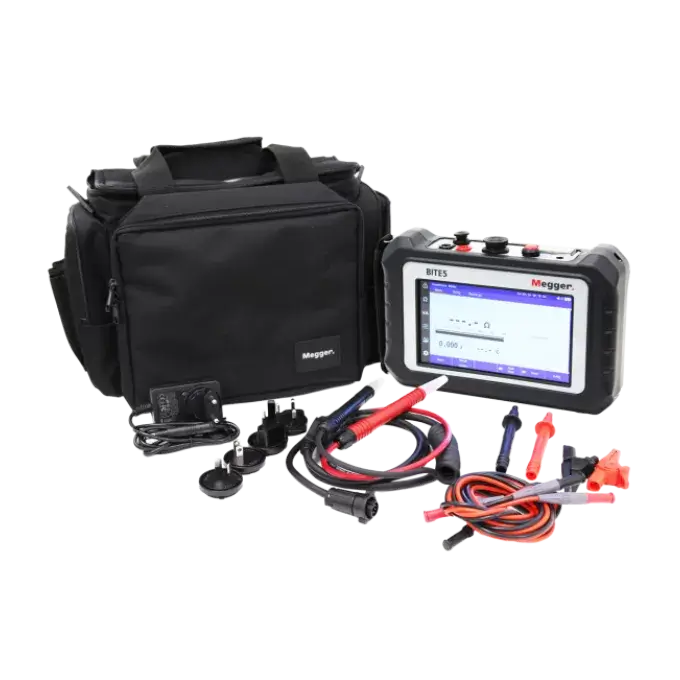
The BITE5 Advanced battery tester let you perform simple tests to quickly evaluate the state of health of lead-acid (VLA and VRLA), NiCd, and lithium-ion batteries. It features an easy-to-use touch-screen interface and supports impedance testing and discharge testing when used in conjunction with a load bank. The BITE5 Advanced allows you to monitor batteries and cells during recharging and test parallel strings without segmenting. With the BITE5, you can perform tests on modules up to 500 V.

Measurement options provided by the BITE5 Advance include cell impedance, cell voltage, ripple voltage, AC ripple current and DC float current. It also has a provision for accurately measuring inter-cell (strap) resistance. 

For impedance tests, you can set pass, warning, and fail limits for impedance and voltage. For discharge tests – and recharge tests with the BITE5 Advanced only – measurements are recorded throughout the full discharge or recharge period. Trends can be displayed on the instrument’s touch screen, and stored results can be downloaded via a USB cable or an SD card for further analysis and archiving. Wireless transfer of data to Megger’s PowerDB software suite is also supported.

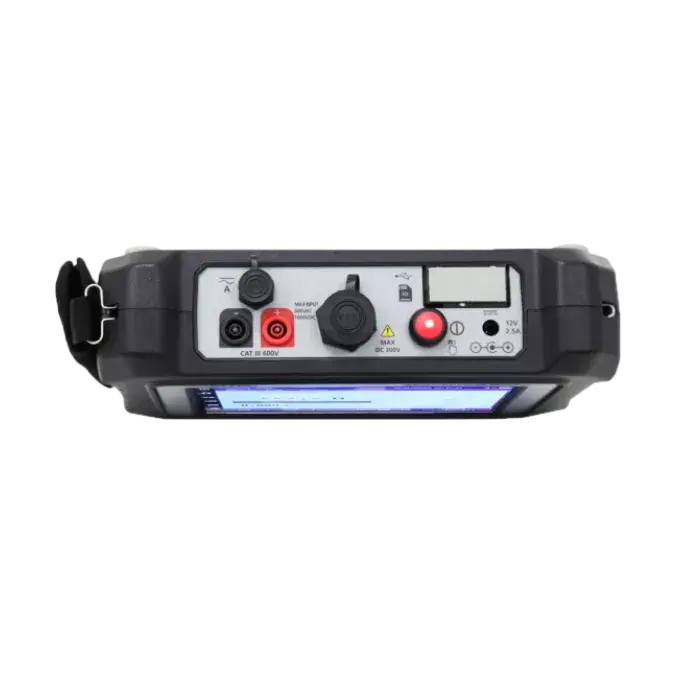
The BITE5 Advanced supports voltage measurement up to 1000 V DC and 600 V AC, which means you can use them to measure solar combiner boxes and check the input and output voltages of inverters used in renewable power systems. An additional feature of the BITE5 Advanced is an RFID tag reader, which allows the instrument to recognize assets without requiring manual data entry.

Product Features:

  • Test multiple battery types
    • The BITE5 Advanced will test lead-acid (VLA and VRLA), NiCd, and lithium-ion batteries.
  • Support for battery discharge testing
    • While performing a discharge test with a Torkel test set, you can use the BITE5 Advanced to measure individual cell voltage, impedance and temperature throughout the test. This will help you identify weaker cells in the string and determine unique impedance baseline values.
  • Touch screen setup and data trending
    • With the touch screen on the BITE5 Advanced you can review data immediately, evaluating individual cells or trending string data and cell performance. Get answers on the spot, make any repairs needed, and re-test to verify the repairs – all in a single trip to the site without transferring or printing data. 
  • Measure impedance on modules up to 500 V
    • New chemistries and applications mean higher voltage battery modules are becoming more common. The BITE5 Advanced can test modules up to 500 V DC

TECHNICAL SPECIFICATIONS:

Data storage and communication

SD Card

Data storage and communicaiton

USB

Power source

Battery

Megger BITE5/BITE5 Advanced FAQ

The frequency of impedance readings varies with battery type, site conditions, and previous maintenance practices. IEEE Recommended Practices suggest semi-annual tests. With that said, Megger recommends that VRLA batteries are measured quarterly due to their unpredictable nature and semi-annually for NiCd and flooded lead-acid.
Many manufacturers now publish impedance values to establish baselines. Several larger organizations who buy many batteries per year have written percent increases of impedance into their battery purchasing specifications for warranty and replacement purposes.
As a battery ages, its characteristics change. In lead-acid batteries, plates corrode and sulphate. In sealed batteries, electrolyte dries out. In Lithium-ion batteries, SEI builds up causing capacitive fading. As these batteries change chemically, their internal impedance changes as well. No ohmic test by any instrument will indicate the remaining capacity; only a discharge test can do that. However, a discharge test is long and expensive and, as such, they are only performed every few years. Batteries can fail within that time frame. Impedance testing provides quick, easy on-line tests that will flag any batteries that may be failing. This can save an entire string because a bad battery can act as a load on the string, damaging adjacent batteries.
The BITE5 can not only be used to test and troubleshoot lithium-ion cells, but it can measure and record the output of solar cells, inverters, and combiner boxes. Combining all these measurements in one device eliminates the need for several individual pieces of equipment.
The BITE5 is designed to measure lead-acid, NiCD, and lithium- ion batteries. These types of batteries can be found in substations, telecom, UPS, data centers, solar and wind applications.
The BITE5 is designed not only to measure lead-acid batteries, but NiCD, and lithium-ion batteries as well. With one connection, you can measure cell voltage, impedance, and temperature. The BITE5 also has the distinct advantage wherein it can be used in conjunction with the TORKEL battery discharge test set to measure the above parameters throughout a discharge test. With the touch screen interface, it is Megger’s easiest impedance tester to use. With touch screen trending, it is also the easiest instrument for making on-site decisions concerning the maintenance and replacement of individual cells. Moreover, it has a built-in voltmeter for basic troubleshooting.
Yes, the BITE 5 has two different concentric probe tips that allow you to access the terminals of the battery through the access hole.
It is the ripple current that generates heat, thus decreasing the life of the battery. A rise of 10 °C will cut the life of the battery in half. Some equipment manufactures, such as those who produce chargers and UPS, may list ripple limits in volts. Therefore, the BITE5 can measure both AC ripple voltage and current.
While performing a discharge test, IEEE requires you to measure the individual cell voltages multiple times throughout the test. Using the BITE5 to measure cell voltage gives you the advantage of measuring impedance at the same time. With the extra data gained from impedance testing, you will be able to see which cells are more susceptible to failure, even though they may not have reached their voltage limit during the test. Additionally, with the impedance data from fully charged cells and from cells throughout and at the end of the discharge test, you can develop baseline impedance data. With the baseline data, you will have pass/fail limits for future impedance tests on the tested battery bank, as well as its specific types of cells.
IEEE 1106-1995, “IEEE Recommended Practice for Installation, Maintenance, Testing and Replacement of Vented Nickel-Cadmium Batteries for Stationary Applications” has similar recommended practices as IEEE 450 for flooded lead-acid batteries.
IEEE 1188-1996, “IEEE Recommended Practice for Maintenance, Testing and Replacement of Valve-Regulated Lead-Acid Batteries for Stationary Applications” defines the recommended tests and frequency. VRLA cells have been classified into tiers of criticality of the installation. The frequency and type of tests vary based on the battery’s tier.
IEEE 450-2002, “IEEE Recommended Practice for Maintenance, Testing and Replacement of Vented Lead-acid Batteries for Stationary Applications” describes the frequency and type of measurements that need to be taken to validate the condition of the battery. The frequency of tests ranges from monthly to annually. Some of the monthly tests include string voltage, appearance, ambient temperature, float current, etc. Quarterly tests include specific gravity, cell voltage, and temperature (on a representative sample of ≥10 % of cells). Annual tests are performed on the entire string. Additionally, the resistance to ground of the battery rack and intercell connection resistance need to be measured. Other tests may need to be performed based on the values measured during periodic tests and battery usage (cycling history).
Dry-out is a phenomenon that occurs due to excessive heat (lack of proper ventilation), over charging (which can cause elevated internal temperatures), high ambient (room) temperatures, etc. At elevated internal temperatures, the sealed cells will vent through the pressure relief valve (PRV). When sufficient electrolyte is vented, the glass matte is no longer in contact with the plates, thus increasing the internal impedance and reducing battery capacity. In some cases, the PRV can be removed and distilled water added (but only in worst case scenarios and by an authorized service company since removing the PRV may void the warranty). This failure mode is easily detected by impedance testing and is one of the more common failure modes of VRLA batteries.
Weight 3 lbs
Dimensions 7 × 5 × 5 in